Introduction
Radar level transmitters are widely used in chemical processing, oil and gas, water treatment, power generation, and other process industries. Two common technologies are guided wave radar and non-contact radar.
Both use microwave signals to determine the distance to a material surface, but they differ in how the signal travels. Guided wave radar directs the signal along a probe that extends into the vessel, while non-contact radar transmits the signal through the space above the material.
Neither technology is universally better. The right choice depends on the vessel geometry, process medium, interface requirements, installation restrictions, and the risk of signal interference.
1. How Does Guided Wave Radar Work?
Guided wave radar (GWR) uses a rod, cable, or coaxial probe installed inside the vessel. The instrument sends a microwave pulse along the probe and evaluates the reflected signal when the pulse encounters a change in the dielectric properties of the material.
Because the signal is guided along a defined path, the technology can be useful in applications where the free-space signal from a non-contact instrument would be more difficult to interpret.
Guided wave radar is commonly considered for liquid level, interface measurement, and selected bulk-solid applications, depending on the probe design and instrument specifications.
Its suitability still depends on process conditions. Probe length, mechanical loading, material buildup, corrosion, and the presence of internal structures must be evaluated before selection.
2. How Does Non-Contact Radar Work?
Non-contact radar sends a microwave signal from an antenna toward the material surface and measures the returning echo without placing a probe in the product.
This arrangement avoids direct mechanical contact with the measured medium. It can be useful for corrosive products, applications where internal contact is undesirable, and tanks where probe installation would be difficult.
Modern non-contact radar transmitters may use frequency-modulated continuous wave (FMCW) technology, including high-frequency designs. The actual measurement capability depends on the selected instrument, antenna, process connection, and application conditions.
However, the signal must travel through the vessel's free space. Internal pipes, agitators, baffles, strong reflections, and an unsuitable nozzle arrangement can create false echoes or weaken the useful signal.
3. Key Differences Between the Two Technologies
| Selection factor |
Guided wave radar |
Non-contact radar |
| Signal path |
Along a rod, cable, or coaxial probe |
Through the space above the material |
| Contact with medium |
Probe contacts the process material |
No probe contacts the measured material |
| Mechanical considerations |
Probe loading, buildup, corrosion, and interference |
Antenna clearance, nozzle geometry, and beam path |
| Interface measurement |
Suitable for many liquid-interface applications with adequate signal conditions |
Typically measures the upper surface; interface measurement depends on the instrument and application |
| Internal obstructions |
Probe must avoid contact with internal structures |
Obstructions can create unwanted echoes |
| Maintenance considerations |
Probe inspection may be necessary in demanding services |
Antenna condition and signal path should be checked |
| Typical selection priority |
A well-defined guided signal path or interface measurement |
Non-contact measurement and suitable antenna access |
These are general tendencies. Actual performance depends on the instrument's design and the process conditions.
4. How Foam, Turbulence, and Low Dielectric Properties Affect Selection
Foam and turbulent surfaces
Foam and surface turbulence can affect radar echoes, but the result depends on the foam properties, process medium, probe or antenna design, and instrument signal processing.
Guided wave radar can provide a strong guided signal in many challenging liquid applications. Non-contact radar may also perform well when correctly selected and installed. Neither technology should be assumed to handle every foam condition without verification.
Low dielectric materials
Radar instruments rely on reflected microwave energy. When the dielectric contrast between the measured material and its surroundings is low, the returned signal may be weaker.
Guided wave radar can be advantageous in some low-dielectric applications because the probe provides a defined signal path. However, minimum dielectric requirements vary by instrument and medium, so the manufacturer's application limits must be checked.
Internal obstructions
For guided wave radar, the probe must be installed so that it does not strike agitators or other moving components. Contact with metal structures can also interfere with the signal.
For non-contact radar, internal objects can create false echoes. Antenna alignment, beam angle, installation position, and echo-processing functions should be considered during engineering.
5. When Is Interface Measurement Required?
Some vessels contain two liquids, such as oil and water, that form distinct layers. In these applications, measuring only the upper liquid surface may not provide the information required by the process.
Guided wave radar can be a suitable option for interface measurement when the instrument can distinguish the relevant reflections and the liquid properties provide sufficient signal separation.
Non-contact radar is generally used to measure the uppermost surface, although specific instruments and measurement arrangements may support more complex applications. Engineers should not assume that a standard non-contact radar transmitter can independently measure a submerged interface.
Before selecting a transmitter, confirm:
-
The upper and lower liquid properties.
-
The dielectric characteristics of both layers.
-
The required level and interface outputs.
-
The expected thickness of the upper layer.
-
Whether emulsions or changing interfaces are present.
-
The manufacturer's stated interface-measurement capability.
These details are particularly important in separators, oil-water tanks, and chemical process vessels.
6. Installation and Maintenance Considerations
Guided wave radar installation
The probe length must suit the vessel and measurement range. Confirm the required clearance from internal structures and evaluate whether the probe can withstand process forces, turbulence, and potential buildup.
For cable probes, mechanical tension and the risk of contact with the tank wall or internal equipment are important. For rod probes, check the available installation space and the effect of deposits or corrosion.
Non-contact radar installation
Select a suitable nozzle and antenna arrangement. The antenna should have an appropriate view of the material surface, and the signal path should avoid significant obstructions where possible.
Consider nozzle height and diameter, mounting location, condensation, deposits on the antenna, and the potential effect of filling streams or agitators on the surface.
Maintenance and commissioning
Both technologies require correct configuration and commissioning. Review the measurement range, reference point, vessel dimensions, false-echo handling, and output configuration.
If readings become unstable, inspect the installation and process conditions before replacing the transmitter. Buildup, incorrect mounting, changing dielectric properties, or a poorly defined measurement range may contribute to the problem.
7. Related Product Options
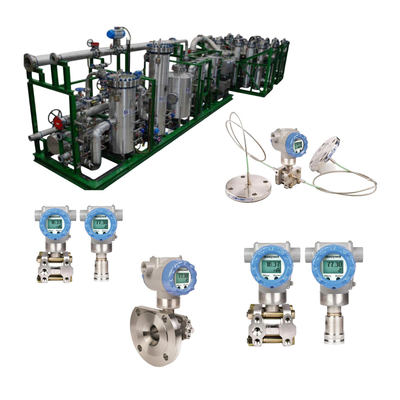
Several manufacturers offer both guided wave and non-contact radar level transmitters.
For guided wave radar, examples include Endress+Hauser Levelflex and ABB LWT300-series instruments. For non-contact radar, suitable options are available from manufacturers such as Rosemount, Endress+Hauser, ABB, and Honeywell.
These product families cover different configurations and operating limits. Model selection should be based on the actual process conditions, required measurement range, process connection, materials, and interface requirements rather than brand alone.
8. A Practical Selection Checklist
Before requesting a quotation, prepare the following information:
-
Medium: Product name, density where relevant, dielectric properties if known, and chemical compatibility requirements.
-
Measurement objective: Total liquid level, interface level, or bulk-solid level.
-
Vessel details: Tank height, diameter, nozzle dimensions, and internal structures.
-
Operating conditions: Pressure, temperature, vapor, foam, turbulence, and filling behavior.
-
Installation constraints: Available mounting position, probe clearance, antenna access, and maintenance requirements.
-
Required performance: Measuring range, accuracy, response time, and output signal.
-
Integration requirements: Communication protocol, control system interface, hazardous-area requirements, and any required approvals.
These details help determine whether guided wave radar or non-contact radar is the more appropriate solution.
Conclusion
Guided wave radar and non-contact radar are both established technologies for industrial level measurement, but they solve different installation and measurement challenges.
Guided wave radar provides a defined signal path along a probe and can be particularly useful for selected interface applications. Non-contact radar avoids direct contact with the material and can be advantageous where probe installation or product compatibility is a concern.
The best choice depends on the measured medium, vessel geometry, internal obstructions, interface requirements, and instrument operating limits. Evaluating these factors early can help prevent unreliable readings and unnecessary maintenance after installation.
Need help selecting a radar level transmitter? Provide the medium, tank dimensions, process conditions, and whether you need total level or interface measurement to help identify a suitable configuration.


 Το μήνυμά σας πρέπει να αποτελείται από 20-3.000 χαρακτήρες!